EN

Motorbike Fog Lights: A Buyer’s Guide to Product Types and Applications
For distributors, private-label programs, and motorcycle manufacturers, motorbike fog lights are not a single interchangeable accessory. The right lamp must fit the intended riding environment, the motorcycle’s electrical system, the available mounting points, and the market’s regulatory expectations. A good purchasing brief starts with the job the light needs to do: create a wide, low foreground beam in poor weather, add long-range reach for night riding, or provide a flexible auxiliary-light option for mixed conditions.
This guide explains how to compare motorbike fog lights by beam type, output, housing format, installation approach, and end-use scenario. It is written for B2B buyers who need a repeatable way to evaluate product families rather than choosing by headline wattage alone.
Start with the lighting role, not the claimed output
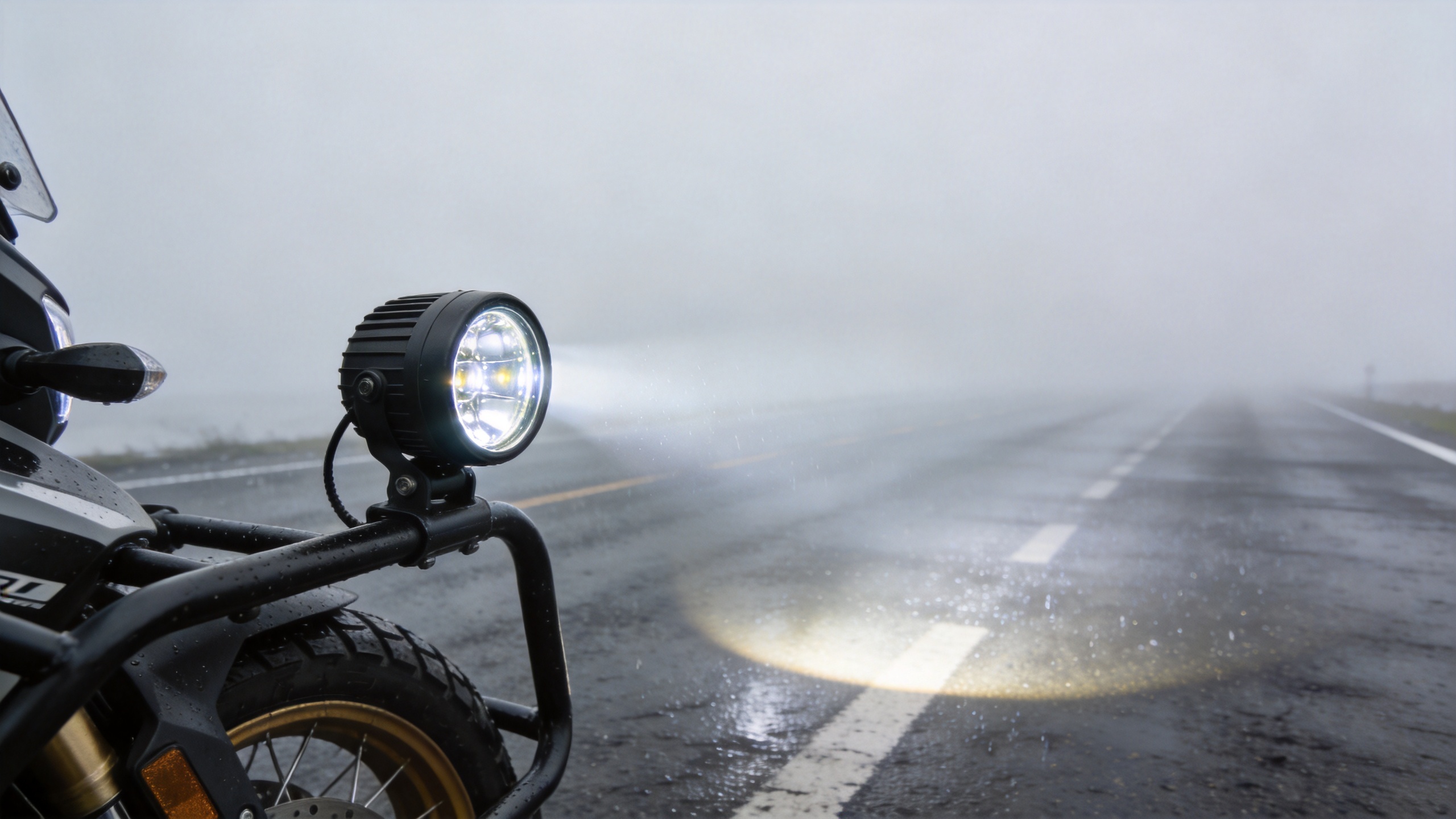
The most useful distinction is between a fog-oriented beam and a driving-oriented beam. Fog-focused motorbike fog lights use a broad, controlled pattern aimed low on the road. Their purpose is to improve near-field definition in fog, rain, spray, or dusty conditions while limiting upward scatter. A driving beam is narrower and reaches farther ahead, making it better suited to open-road or trail use where forward distance matters more than a wide foreground spread.
As a general reference, motorcycle fog beams are often described as roughly 35° to 50° wide, though the real pattern depends on the optic and the mounting height. Treat this range as a comparison prompt, not as a universal specification. Request beam photos, beam-angle data, and a clear explanation of the high/low or fog/driving mode before approving a sample.
For a catalog that serves multiple rider types, separating beam roles is clearer than labeling every auxiliary lamp as a bike fog lamp. It helps the buyer place the correct item in commuter, touring, adventure, off-road, or OEM fitment programs.
Compare product formats and beam configurations
Compact round auxiliary lamps
Round lamps are common where buyers need a familiar appearance, flexible bracket placement, and a product that can work across several motorcycle styles. Diameter affects the available optic area and the visual balance on the fork, crash bar, or fairing. Check the mounting stud, bracket thickness, aiming adjustment, and clearance around suspension movement—not just the lamp body size.
Square or pod-style lamps
Pod designs can package a concentrated optic in a compact footprint. They are often considered for adventure motorcycles, utility bikes, or custom builds with limited mounting space. When evaluating these motorbike fog lights, compare heat-management design, connector placement, and whether the beam remains appropriate after the lamp is mounted at the intended height and spacing.
Dual-mode high/low-beam auxiliary lights
A dual-mode product can simplify assortment planning when a distributor wants one housing family for different applications. Still, the switching behavior must be verified: ask whether the low mode is a genuinely controlled fog pattern or simply reduced intensity, how the high mode is triggered, and which harness components are included. A 3.7-inch, 100W external motorcycle auxiliary-fog-light model with high/low beam is available in the YIAALUX motorcycle auxiliary fog light range; buyers should confirm the final configuration and compatibility for their target program before ordering.
Match power, thermal design, and wiring to the motorcycle
Wattage alone does not define useful lighting performance. For motorbike fog lights, ask for the operating voltage range, actual current draw, thermal-management design, connector type, and recommended fuse and relay arrangement. A lamp that looks suitable on a bench can become a poor fit if the motorcycle’s charging capacity, accessory circuit, or harness routing is overlooked.
Installation planning normally involves three linked decisions: where the lamps mount, how wiring is routed, and how switching is protected. A relay, fuse, weather-resistant connectors, and a harness sized for the actual load are practical evaluation points. For OEM or bulk purchasing, request a wiring diagram and identify whether the supplied kit includes the bracket, harness, switch, relay, and fasteners—or whether these must be sourced separately.
Choose the mounting method for the intended application
Fork mounts, crash-bar clamps, fairing brackets, and model-specific mounts all solve different fitment problems. Touring and adventure applications may prioritize adjustability and vibration resistance. Urban commuter applications may prioritize a compact profile and simple replacement. Off-road-focused programs may require greater attention to impact exposure and water or dust ingress.
Before placing a production order, confirm tube diameter or mounting-hole dimensions, lamp spacing, steering clearance, cable length, and aiming range. A rider discussion found in search results highlights a frequent real-world issue: a lamp can be acceptable while the supplied mount does not fit the motorcycle’s fork diameter. This is why a bike fog lamp should be sampled as a system—lamp, bracket, harness, and motorcycle—not as a loose component.
A B2B purchase checklist for motorbike fog lights
- Beam evidence: Request beam-pattern images and confirm fog, driving, or dual-mode positioning.
- Electrical evidence: Verify voltage, current draw, harness contents, fuse guidance, and switch logic.
- Mechanical fit: Check bracket dimensions, adjustment range, vibration resistance, and vehicle clearance.
- Environmental suitability: Ask for the specific ingress-protection, material, and test information applicable to the supplied model; do not assume a general waterproof claim applies to every configuration.
- Compliance planning: Confirm the relevant destination-market requirements and obtain model-specific documentation before using compliance language in sales materials.
- Commercial readiness: Define packaging, branding, spare parts, MOQ, and whether OEM/ODM changes affect the approved configuration.
Make the application decision clear for the end user
The strongest product presentation links motorbike fog lights to a real use case. For wet-weather commuting, prioritize controlled low-angle illumination and uncomplicated switching. For touring, prioritize serviceable mounting, reliable wiring, and a beam that complements the headlamp. For adventure or mixed-surface riding, review bracket strength, vibration exposure, and the practical value of a dual-mode setup. For OEM projects, add fitment validation, documentation, and repeatable assembly requirements to the evaluation process.
In short, a better purchase decision comes from matching optic, electrical design, mounting hardware, and rider scenario together. That approach makes it easier for wholesalers and manufacturers to build an auxiliary-light range that is easier to specify, support, and sell.