EN
EN

How to Evaluate E-Mark Motorcycle Headlights for Export Markets
For an importer, distributor, or motorcycle OEM, buying led spotlights for motorcycles is not simply a matter of comparing lumen claims and housing style. Once a product is intended for an export market, the decision must connect product identity, approval evidence, intended use, vehicle fitment, installation instructions, and the rules that apply where the bike will be registered. This is especially important for BMW GS adventure applications, where motorcycle auxiliary lights may be installed for long-distance, night, or off-road-oriented riding.
This guide sets out a practical evaluation method for E-mark motorcycle headlights and motorcycle auxiliary lights. It also helps buyers compare led spotlights for motorcycles without reducing the decision to a generic brightness claim. It is designed for B2B buyers who need to make a defensible purchasing decision before a container order, a private-label launch, or an OEM supply discussion.
Start by separating an E-mark from a blanket compliance claim
An E-mark is an approval marking used within the UNECE type-approval framework. It should be treated as evidence to verify, not as a shortcut that proves every export, installation, and vehicle-use requirement has been met. The mark, approval number, applicable regulation, lamp function, and documentation should all line up.
For lighting, UN Regulation No. 148 provides a type-approval framework for devices that make a vehicle visible or provide lighting or signalling functions. However, the relevant approval scope depends on what the lamp is designed to do. A buyer should therefore ask whether the item is presented as a headlamp, driving lamp, front fog lamp, daytime running lamp, position lamp, or another function. Do not accept “E-mark certified” as the entire answer. The same discipline applies whether you source replacement lamps or led spotlights for motorcycles for an accessory catalogue.
There is a second distinction that is often missed during sourcing: electromagnetic compatibility. UN Regulation No. 10 concerns EMC for vehicles and electrical/electronic subassemblies. An EMC approval and a lighting-function approval are different checks. For led spotlights for motorcycles, a clean procurement file should show exactly which requirements the supplier claims, which documents support them, and which requirements remain the vehicle maker’s or importer’s responsibility.
Check the mark and approval evidence as a matched set
Ask the supplier for clear, traceable evidence before approving a sample. The most useful package normally includes photos of the marking on the lamp or label, the approval certificate or report where available, the product model designation, technical drawings, and an installation manual. Every document should identify the same product version.
- Approval mark: Obtain a legible close-up and confirm that it is permanently associated with the product rather than added only to sales artwork.
- Model correlation: Match the certificate model, packaging label, product label, and purchase-order description. Small changes in LEDs, optics, driver, lens, or housing can matter.
- Function and beam: Confirm whether the stated approval applies to the actual beam function you will sell. A spot-oriented unit, a wide auxiliary unit, and a replacement headlamp should not be treated as interchangeable.
- Revision control: Request a declaration that defines the controlled version. For private-label work, clarify whether branding or connector changes affect the documented product configuration.
These checks help a buyer avoid a common failure: receiving motorcycle auxiliary lights whose documents describe a related family but not the exact SKU being imported.
Evaluate fitment before promising BMW GS compatibility
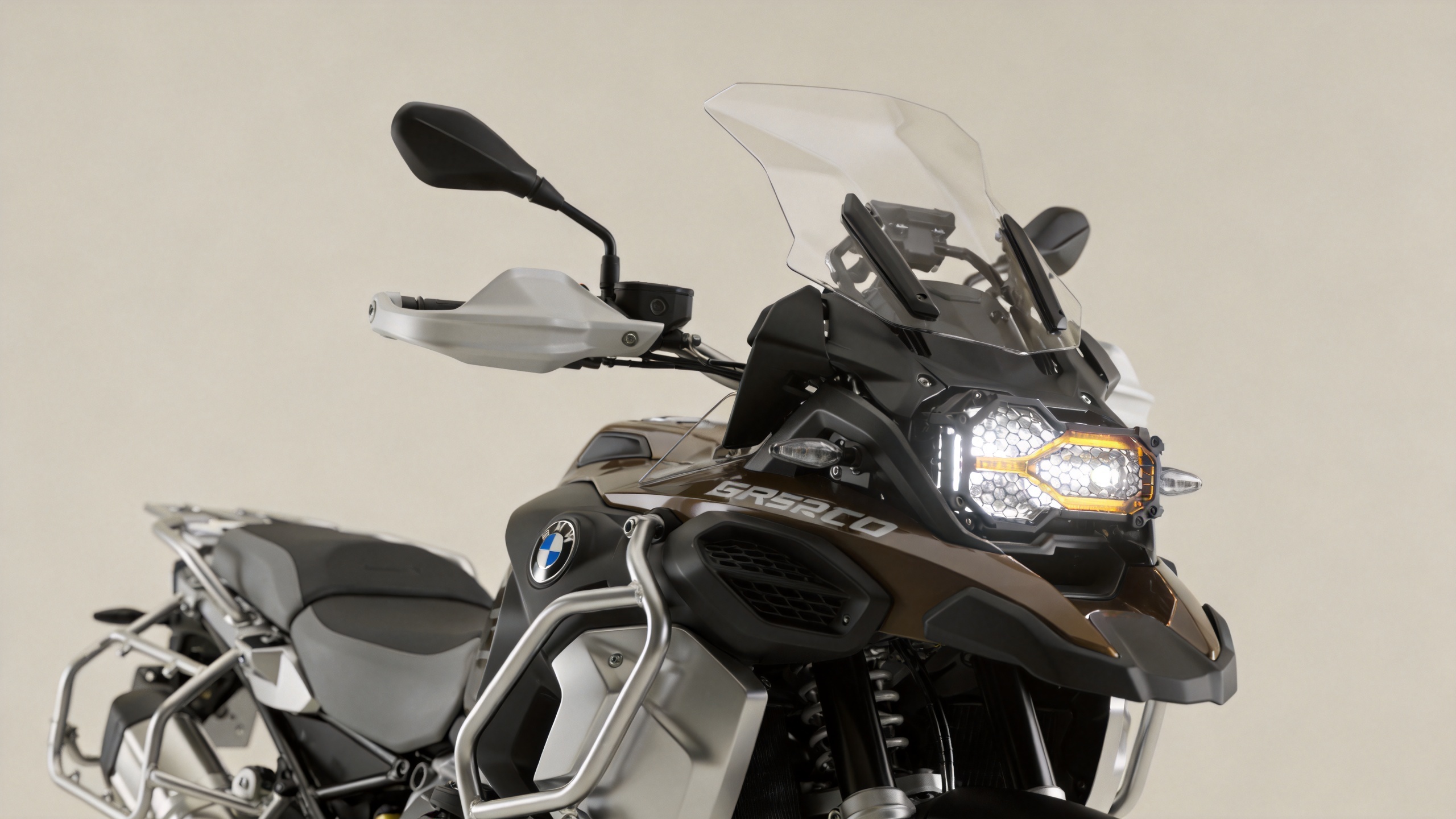
Adventure-bike buyers value fitment, but a fitment claim should be evidence-based. For BMW GS platforms, confirm the exact motorcycle models and years covered, the mounting position, bracket interface, clearance around bodywork and steering travel, cable routing, and the electrical connection method. A product that physically mounts to one GS generation may not fit another without a different bracket or harness.
For example, the available product record for E-mark certified LED driving headlight for BMW F800GS, F700GS, and F650GS applications identifies a defined fitment family. Buyers should still verify the supplied bracket, harness, and mounting instructions against their planned model list before making an end-customer compatibility promise.
Make the sample evaluation realistic. Fit the lamp to a representative motorcycle, inspect vibration exposure and heat clearance, check connector sealing and strain relief, and verify that the switching approach does not create an unexpected warning, interference, or battery-drain issue. Those installation records are as valuable as the first light-on test when you later train distributors or handle warranty claims.
Match the lamp to the destination market and intended road use
Export compliance is market-specific. A product acceptable for an off-road accessory range, a replacement part, or a specific approval route may not be sold, installed, or advertised in the same way in every country. Before ordering led spotlights for motorcycles, create a destination-market matrix with the target country, intended use, applicable product function, vehicle-installation rules, required documentation, labelling language, and importer responsibilities.
For a decision-stage purchase, use three questions: Is the lamp approved for the claimed function? Is the planned installation permitted on the target motorcycle and market? Can the local importer substantiate the claim with the documents delivered in the shipment? If any answer is uncertain, market the item conservatively until local regulatory advice and product evidence are complete.
Build a repeatable scorecard for led spotlights for motorcycles
Use the same scorecard for every candidate. For led spotlights for motorcycles, score approval evidence, exact product identity, beam function, BMW GS fitment, wiring method, document completeness, and destination-market claim language. This approach prevents a visually similar unit from replacing the approved configuration during sourcing.
| Evaluation area | Buyer evidence to request | Decision question |
|---|---|---|
| Approval identity | Marking photo, model record, approval documents | Does the evidence identify this exact lamp? |
| Application | Beam description and installation instructions | Are these led spotlights for motorcycles being sold for the stated function? |
| Compatibility | Fitment list, bracket and harness details | Does the solution fit the intended BMW GS models? |
| Commercial control | Packaging, label artwork, revision record | Can the imported unit remain traceable after production? |
For a distributor, motorcycle auxiliary lights should be accepted only when the scorecard and physical sample tell the same story. Keep the scorecard with the purchase order so sales teams use compliant, supportable product claims.
Use a supplier acceptance checklist before production
- Lock the exact SKU, optics, driver, lens, connector, bracket, and label version in the purchase order.
- Receive product-marking photos and approval documents for that controlled version.
- Confirm the lamp function, beam purpose, and claim language for each export market.
- Validate BMW GS fitment with a physical sample and record any model-year limitations.
- Request installation instructions, wiring guidance, packaging artwork, and traceability information.
- Define incoming inspection points: mark legibility, light function, connector condition, mounting hardware, and documentation completeness.
Make compliance evidence part of the commercial decision
A sound purchase decision balances product performance with evidence quality. A supplier of led spotlights for motorcycles that can provide model-specific documents, disciplined labelling, fitment support, and clear technical communication reduces the risk of delayed listings, border questions, returns, and disputed claims. For export buyers of led spotlights for motorcycles, that discipline matters more than a broad “approved” label.
YIAALUX serves automotive and motorcycle lighting buyers across export markets and can support product discussions with the documentation and fitment questions that should be resolved before bulk procurement. Build the compliance file first, validate the sample second, and only then scale the order.