 EN
EN
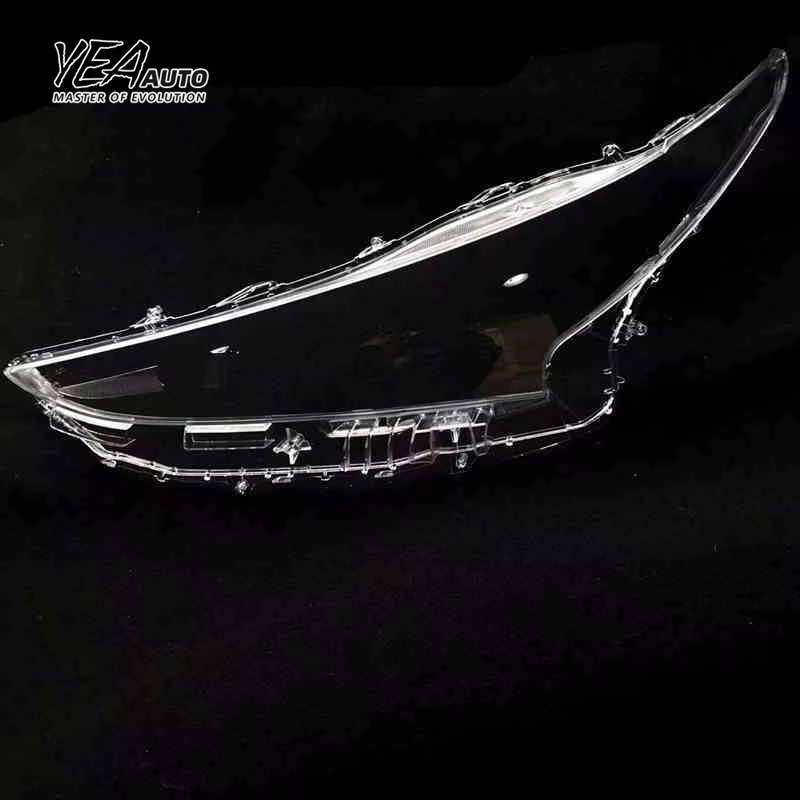
Within the complex eco system in car headlamp, each component is important in providing safe and effective light. Although the light source (LED, laser, or HID) and the reflector or projector module are the active source of light, the headlight glass should be called the cover or lens is the decisive optical gateway. Its design and quality forms the core of gaining and sustaining a stable, accurate and legally acceptable distribution of light beam all through the life of the vehicle.
Precision Optics: bending the Raw Delivery.
The main purpose of the lens is to serve as a correctional and shaping optical piece. The crude light of the source and reflector is not yet fit to the road; there is refinement it needs.
Beam Pattern Formation: The inside of the good lens is not smooth. It is also made with a sophisticated collection of micro-optical parts prisms, flutes as well as lenses lets, all molded. These characteristics are computed mathematically to bend (refract) to focus the incoming rays of light. Their task is to produce the characteristic, controlled beam shapes - the crisp horizontal segment of a low beam (so as to avoid glare to other coming traffic) and the wide, extended one of a high beam.
Removing Hot Spots and Artifacts: The lens is designed to provide a smooth and even distribution of light all over the lit field. It smooths out the light eliminating irregularities, striations or excessively bright points that might cause distraction to the driver or pose a hazardous glare.
Assurance of the Long-Term Optical Stability.
Stability is not merely with the first performance, but with its sustained performance over several years with dejecting conditions. The eye of the long-term consistency is the lens.
No Yellowing, Hazing of Lenses: It should not yellow and hazard degrade the environment as mentioned in the earlier blogs. Any deterioration combines to near random scattering of light, blurring the beam cutoff and transforming a beam into a diffused wall of light which additionally dazzles other cars whilst slightly diminishing the sections of the beam useful to forward illumination. Optical stability is vital to the provision of high-quality UV-resistant coatings and substrate materials.
Dimensional and Thermal Stability: The lens should have the specific shape and geometry on its surface. It does not bend in the high temperatures of the hood or harden in the low ones. Warpage provides distortion of the beam pattern altering the angles of the micro-optical elements. Stable polycarbonate with high grade ensures that the beam distribution measured out is correct when the heat of the desert is low as well as during winter frost since it is designed with proper thermal management.
Offering Secured and Restricted Optical Road.
The beam distribution may only become stable in case the optical path in the headlamp assembly is clean.
Forming a Hermetic Seal: The lens is a closed box containing the rest of the housing so that nothing can penetrate (moisture, dust, contaminant) and spoil the film. The condensation or dirt on the inside of reflector surfaces or inside of the lens would randomly obstacle and disperse the light altogether destabilizing the beam outburst. The ultimate, tough seal is a must.
Protective Hard Coat: The external hard coating does not only resist scratches. When the surface is scratched, it functions as a row of mini diffusers and it reflects the light, producing halo effects on the beam. The lens has a clean, scratch-free surface ensuring that the light leaves the lens in a clean, predictable manner.
Connection with the Complex Lighting Systems.
Lighting systems such as Adaptive Driving Beams (ADB) or a matrix LED system require even more light requirements of the lens.
High-Fidelity Projection: These systems are dynamic systems that project pixel patterns of light pattern with precision. These complex patterns should pass through the lens satisfactorily without being distorted, ghosted or blurred. This demands high optical consistency and accuracy of the molding of the lenses.
Uniformity to Multi-Source Systems: The lens is useful in systems that incorporate a number of LED chips or light guides, which must combine the output of several sources into a single homogeneous beam, making visible junctions or color and brightness variations.
The last, but the ultimate quality control gating light is the automotive headlight lens. Its functions in assisting uniform beam delivery are versatile: it is an optical duster that is precise, and is an environmental guard, and it is a consistent structural element. Any trade-off in the lens quality directly causes a trade-off in the beam performance- high levels of glare, lower levels of visibility and violation of safety rules. Thus, it is not a trivial specifics that a lens is designed with the characteristics of optical precision and long-term durability; it is rather a prerequisite toward achieving the uniform, safe light, which is the cornerstone of the modern automotive lighting.