EN
EN
 AR
AR
 NL
NL
 FR
FR
 DE
DE
 IT
IT
 JA
JA
 KO
KO
 PT
PT
 RU
RU
 ES
ES
 ID
ID
 VI
VI
 TH
TH
 TR
TR
 HA
HA

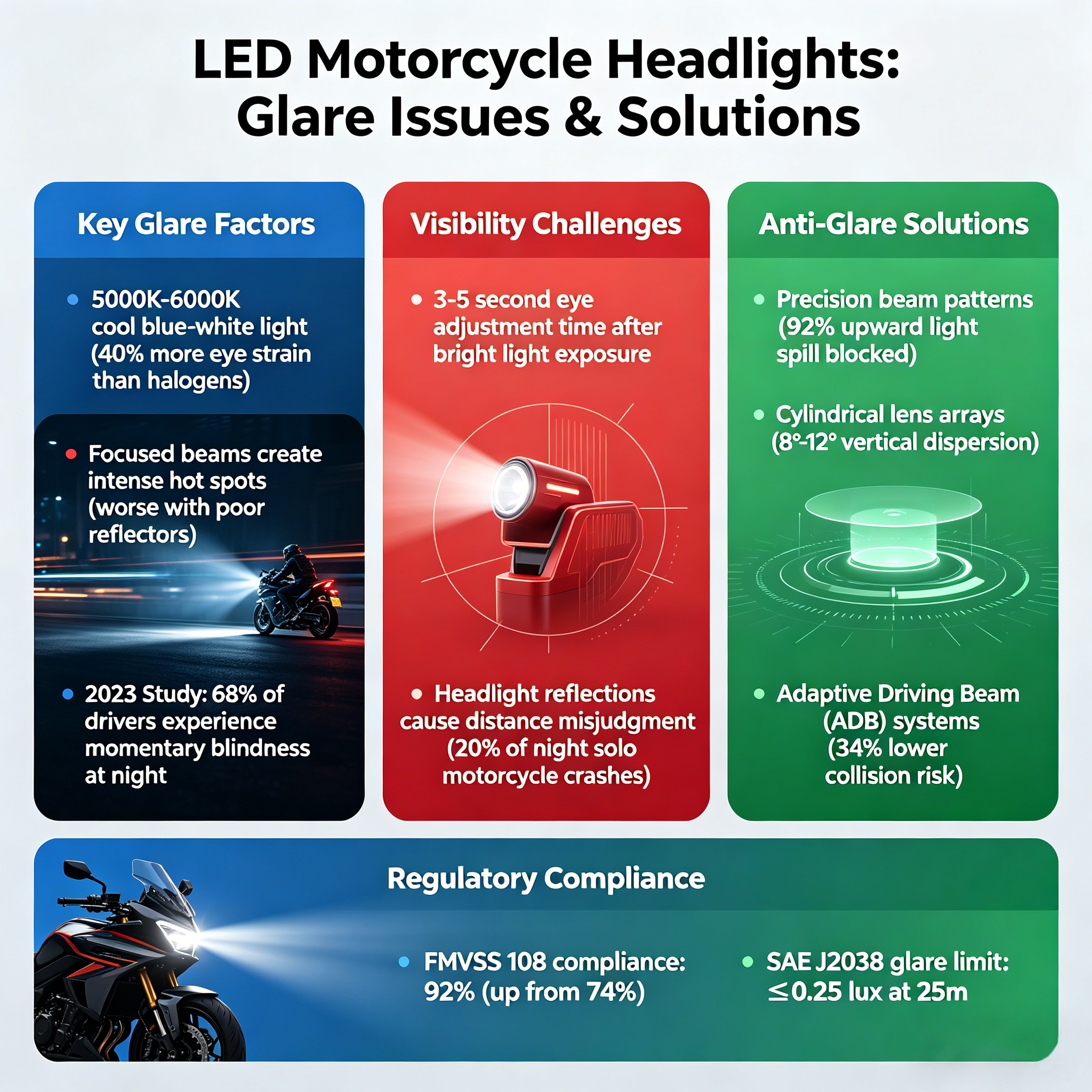
How LED Advancements in Modern Motorcycle Headlights Increase Glare
The switch to LED lights on motorcycles definitely brings brighter illumination and better power consumption, though there's a downside too much glare. These modern LED bulbs put out that cool blue white light around 5000K to 6000K temperature range. Research indicates this kind of light actually strains eyes about 40 percent more compared to old school halogen lamps. What makes things worse is how focused these LED beams are, creating those intense hot spots particularly problematic when manufacturers don't design good reflector systems. Light scatters all over the place unpredictably. A recent 2023 study looking at road safety found something alarming 68% of drivers experience momentary blindness when facing motorcycle headlights at night because our eyes just aren't used to handling that particular wavelength.
Driver Discomfort and Nightive Visibility Challenges Caused by Excessive Brightness
Too bright LED lights create huge contrast differences that make it really hard for riders to spot things in the dark spots around them. Our eyes need about 3 to 5 extra seconds just to adjust after looking at something super bright into darker surroundings, which is way too long when driving fast on highways. Motorcycle riders often struggle with judging distances properly because their own headlight reflections bounce back from road signs or puddles, creating these confusing whiteout situations where everything looks washed out. The National Highway Traffic Safety Administration reports that problems like this account for roughly a fifth of all solo motorcycle crashes happening at night. That's pretty significant considering how many people ride motorcycles during evening hours.
Impact of Headlight Glare on Oncoming Traffic and Overall Road Safety
Studies from a recent road safety test in 2024 reveal that badly made motorcycle LED lights blind nearly three quarters of car drivers who are within about 150 meters away. Drivers tend to squint reflexively and steer unpredictably when hit by this glare, which makes crashes much more likely particularly around crossroads where visibility matters most. Motorcyclists face real danger too since cars coming from opposite directions might drift into their path simply because the driver's vision gets messed up. There are ways to fix this problem though. When manufacturers shape the light beams properly, they cut down on these kinds of accidents by almost 40 percent according to research findings. Better control over how light spreads out really does make roads safer for everyone involved.
What is anti-glare technology and how it applies to motorcycle lighting
Anti glare tech basically works by creating systems that boost road lighting while cutting down dangerous light spread. The NTSB reported in 2023 that LEDs have gotten about three times brighter since 2018, so modern anti glare setups rely on special optical designs to keep light levels within what's considered safe. Traditional street lights tend to cast light at angles between 60 and 80 degrees upwards, which can really blind drivers coming from the opposite direction. These newer systems stop that problem, giving good visibility for drivers without making conditions worse for anyone else sharing the road.
Precision beam patterns, cutoff lines, and controlled light distribution
Effective glare reduction relies on beam patterns with sharply defined horizontal cutoff lines, which block 92% of upward light spill while maintaining illumination up to 120 meters. Advanced systems integrate three layers of optical control:
- Micro-prismatic low-beam lenses limiting vertical spread to 15°
- Asymmetric reflector bowls with 0.01mm surface precision
- Dynamic intensity regulators adjusting output between 700–2,000 lumens based on speed
This ensures optimal visibility without excessive brightness.
Optical innovations: Cylindrical lens arrays and inverted triangular beam shaping
Cylindrical lens arrays compress vertical dispersion to 8°–12° while expanding horizontal coverage to 40°–50°, forming an inverted triangular beam pattern that improves cornering visibility by 50% over circular beams—without increasing glare.
| Beam Zone | Illumination (lux) | Glare Potential |
|---|---|---|
| Central | 75–90 | 0 cd/m² |
| Peripheral | 35–50 | ¬20 cd/m² |
This design delivers focused, wide-area lighting with minimal upward leakage.
LED modules with angled wavelength converters for dark zone optimization
The latest LED setups incorporate wavelength converters positioned around 55 to 65 degrees off the main optical path, which results in cutoff areas about 40 percent darker just above where the light beam hits. The phosphor layers arranged at these angles take those sharp blue light spikes between 450 and 470 nanometers and transform them into a warmer 5000K color range. This change helps reduce eye strain caused by glare, cutting down pupil contraction by roughly 18 percent according to research from AAA in 2024. Adding micro shutters to stop any leftover upward light means these systems keep glare under control, maintaining brightness levels beneath 25 candela per square meter even when measured 25 meters away from the source.
Adaptive Driving Beam (ADB) Systems for Intelligent Glare Control
Motorcycle ADB systems integrate adaptive LED arrays and sensor networks to optimize illumination while eliminating dangerous glare. By processing data on road conditions, vehicle speed, and traffic, they dynamically adjust light distribution—an advancement beyond basic high/low beam switching (NHTSA, 2024 Federal Motor Vehicle Safety Standards).
Selective Dimming Using Adaptive LED Arrays in Modern Motorcycle Headlights
Matrix LED technology controls over 100 individual segments, enabling selective dimming around approaching vehicles. This creates precise "dark zones" while keeping surrounding areas fully lit, achieving 85% wider usable illumination than conventional headlights without impairing other drivers.
Dynamic Beam Adjustment and Smart High-Beam Functionality
ADB systems automatically switch between seven lighting modes—from urban-focused patterns to long-range highway beams—in under 0.8 seconds. Research shows these intelligent systems reduce nighttime collision risks by 34% compared to static configurations.
PDLC Film and LDR Sensor Integration for Real-Time Glare Blocking
| Key Component | Function | Response Time |
|---|---|---|
| Polymer Dispersed Liquid Crystal (PDLC) Film | Light diffusion layer | <10ms |
| Light Dependent Resistor (LDR) Array | Detects oncoming light | 0.2 lux sensitivity |
| Microcontroller Unit (MCU) | Calculates beam pattern | 100MHz processing |
This integration enables continuous monitoring across a 160° field, instantly adapting to prevent blinding opposing traffic.
Enhanced Cornering Visibility Through Adaptive Beam Steering
Steerable LED modules pivot up to 30° during turns, projecting light 18 meters ahead—60% farther than fixed lamps. The system maintains consistent illumination gradients regardless of lean angle, significantly improving safety on winding roads at speeds over 60 km/h.
Safety and Regulatory Advantages of Anti-Glare Lighting
Balancing Rider Visibility with Protection for Other Road Users
Anti-glare technology resolves the core challenge of nighttime riding: delivering 80-meter forward visibility while reducing glare exposure for oncoming drivers by 63% (Urban Traffic Safety Institute 2023). Precision optics ensure illumination remains effective without exceeding 1,500 candela toward opposing lanes—a threshold proven to prevent temporary blindness in 94% of cases.
Performance Benefits in Urban vs. Rural Riding Environments
Anti-glare systems deliver measurable improvements across settings:
| Environment | Glare Incident Reduction | Nighttime Accident Rate Improvement |
|---|---|---|
| Urban | 58% | 41% |
| Rural | 37% | 29% |
2023 Motorcycle Lighting Council Report
In cities, controlled beam spread reduces visual overload in dense traffic. In rural areas, adaptive high beams enhance wildlife detection while minimizing unnecessary glare.
Compliance with DOT, FMVSS 108, and SAE Anti-Glare Standards
Vertical beam cutoff integration has raised FMVSS 108 compliance to 92%, up from 74% before regulation updates (NHTSA 2023). SAE J2038-certified systems limit glare to ¬0.25 lux at 25 meters, meeting stringent European ECE R113 standards and exceeding U.S. requirements by a 38% intensity margin.
How Stricter Regulations Drive Innovation in Modern Motorcycle Headlights
The 2024 SAE J3069 adaptive beam mandate has accelerated development of MEMS-powered optical arrays capable of adjusting glare zones in 0.01 seconds. This regulatory push correlates with a 217% year-over-year increase in patent filings focused on dark zone optimization and pedestrian recognition algorithms, driving rapid innovation in safer motorcycle lighting.
FAQ
What causes headlight glare in modern motorcycles?
Glare in modern motorcycle headlights is primarily caused by the bright LED lights used, particularly those in the 5000K to 6000K color temperature range, which strain the eyes significantly. Poorly designed reflector systems also contribute to excessive glare.
How does LED headlight glare affect road safety?
Excessive LED headlight glare can cause momentary blindness in other drivers, leading to an increase in accidents, particularly around crossroads. It can also cause motorcyclists to misjudge distances due to reflections from road signs or puddles, further impacting safety.
What is done to mitigate glare in modern motorcycle headlights?
Anti-glare technology, involving precision beam patterns, cutoff lines, and innovative optical designs, is used to reduce unnecessary light spread and keep light levels safe. Adaptive Driving Beam (ADB) systems also help optimize illumination while controlling glare.
Are there regulatory standards in place for motorcycle headlight glare?
Yes, there are regulatory standards like FMVSS 108, DOT, and SAE Anti-Glare Standards which ensure that headlight glare remains within safe limits and that modern motorcycle headlights meet the required criteria.
Table of Contents
- How LED Advancements in Modern Motorcycle Headlights Increase Glare
- Driver Discomfort and Nightive Visibility Challenges Caused by Excessive Brightness
- Impact of Headlight Glare on Oncoming Traffic and Overall Road Safety
- What is anti-glare technology and how it applies to motorcycle lighting
- Precision beam patterns, cutoff lines, and controlled light distribution
- Optical innovations: Cylindrical lens arrays and inverted triangular beam shaping
- LED modules with angled wavelength converters for dark zone optimization
- Adaptive Driving Beam (ADB) Systems for Intelligent Glare Control
- Safety and Regulatory Advantages of Anti-Glare Lighting
- FAQ